
Hinged or sliding
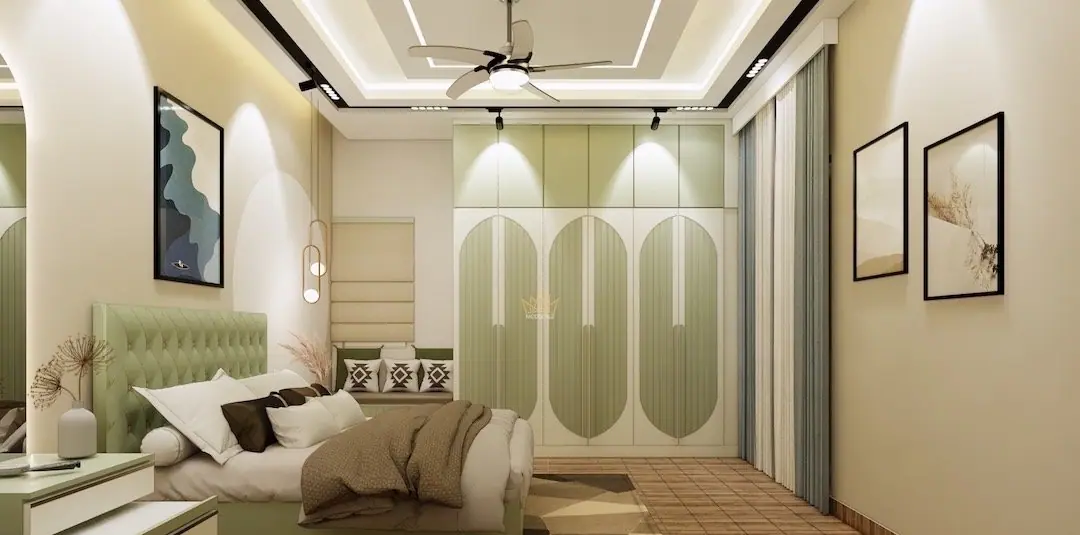
Hinged gives you the full opening, full-depth shelves, and internal fittings that can extend forwards. It needs swing clearance — roughly 600mm in front of the shutter.
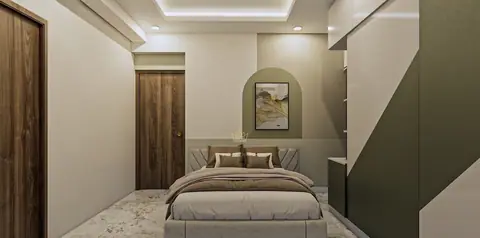
Sliding costs you about a third of the internal access at any moment and a little depth to the track, but needs no clearance at all. In a bedroom where the bed sits close to the wardrobe wall, that trade is usually worth it.
A common good answer in a compact Bengaluru bedroom: sliding on the long run facing the bed, hinged on the shorter return.
How much you actually need
Measure what you own rather than estimating. As a starting point: two adults typically need six to eight running feet at 2100mm height; a family of four needs twelve to sixteen across the home; one teenager comfortably fills four on their own.
Then use the height. The 500–600mm above a 2100mm wardrobe is the cheapest storage in the house and is the correct home for suitcases, seasonal bedding and things you touch twice a year.
Internals worth paying for
Pull-out trouser rack — turns a folded pile into something you can actually see. Jewellery or accessory tray with a soft lining. Pull-out laundry basket, which quietly removes the basket from your bedroom floor. Adjustable shelving, because what you own changes. A mirror on the inside of a shutter rather than on the wall. Wardrobe lighting — a strip that comes on with the door, at 3000K so colours read correctly.
Worth less than people spend on it: heavily compartmentalised fixed shelving, deep drawers that become archaeology, and rotating carousels in anything other than a corner.
Dimensions that matter
Internal depth 550–600mm — below 500mm a hanger sits at an angle and the shutter rubs. Hanging rod height 1050mm for shirts, 1600mm for long garments. Shelf spacing 350–400mm for folded stacks. Drawer depth 150–200mm for the top drawer; deeper below.
Leave a 50mm scribe filler where the wardrobe meets a wall. Walls in Bengaluru apartments are rarely square, and a filler is the difference between a clean line and a visible taper.
Materials, briefly
BWR plywood carcass is correct for a dry bedroom; BWP is over-specification unless the wardrobe backs onto a bathroom wall. Edge-band every cut edge, including the ones inside. For the shutter, a 1mm matte textured laminate hides fingerprints far better than gloss and costs a fraction of acrylic. Use soft-close hinges everywhere — you open these with your hands full.
Want this applied to your own home? Start a project or read the material library.